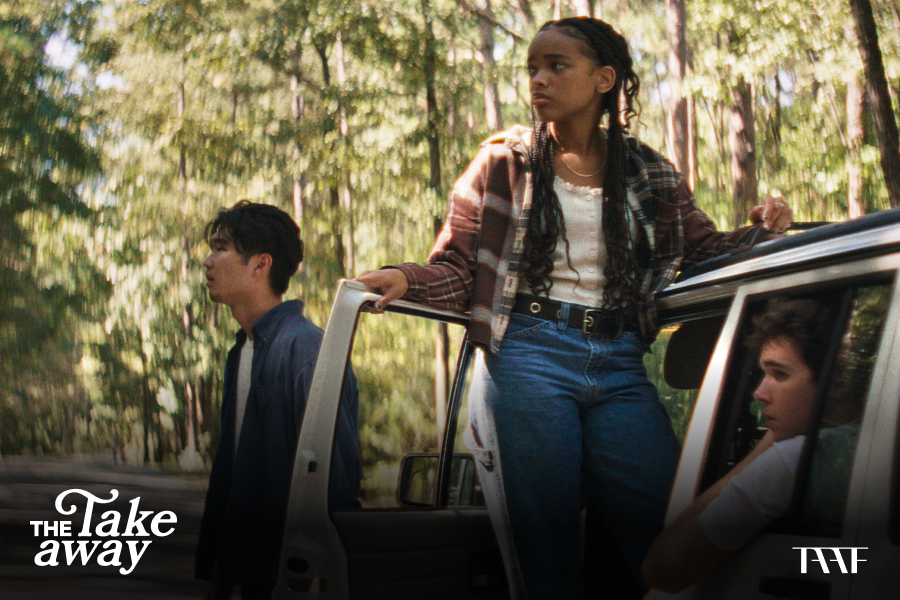
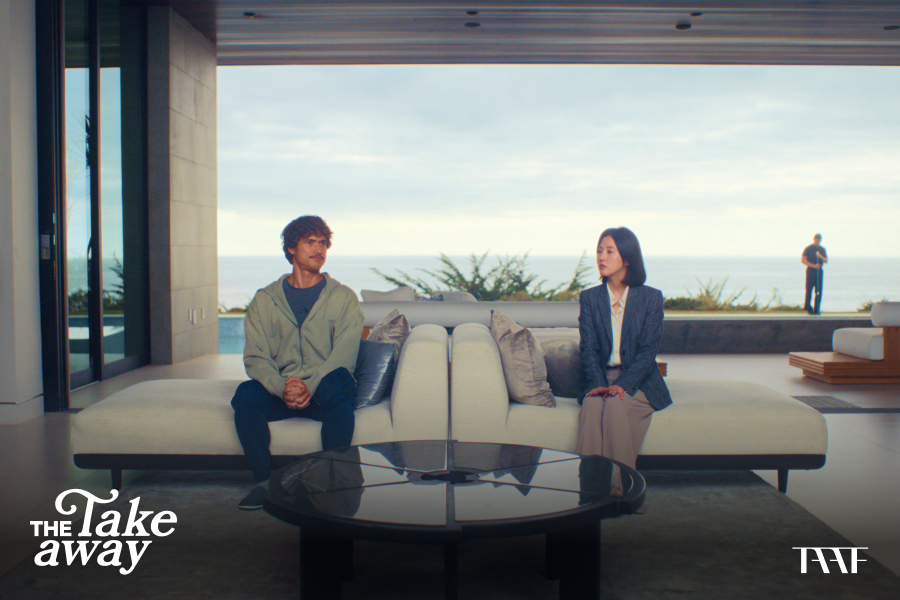
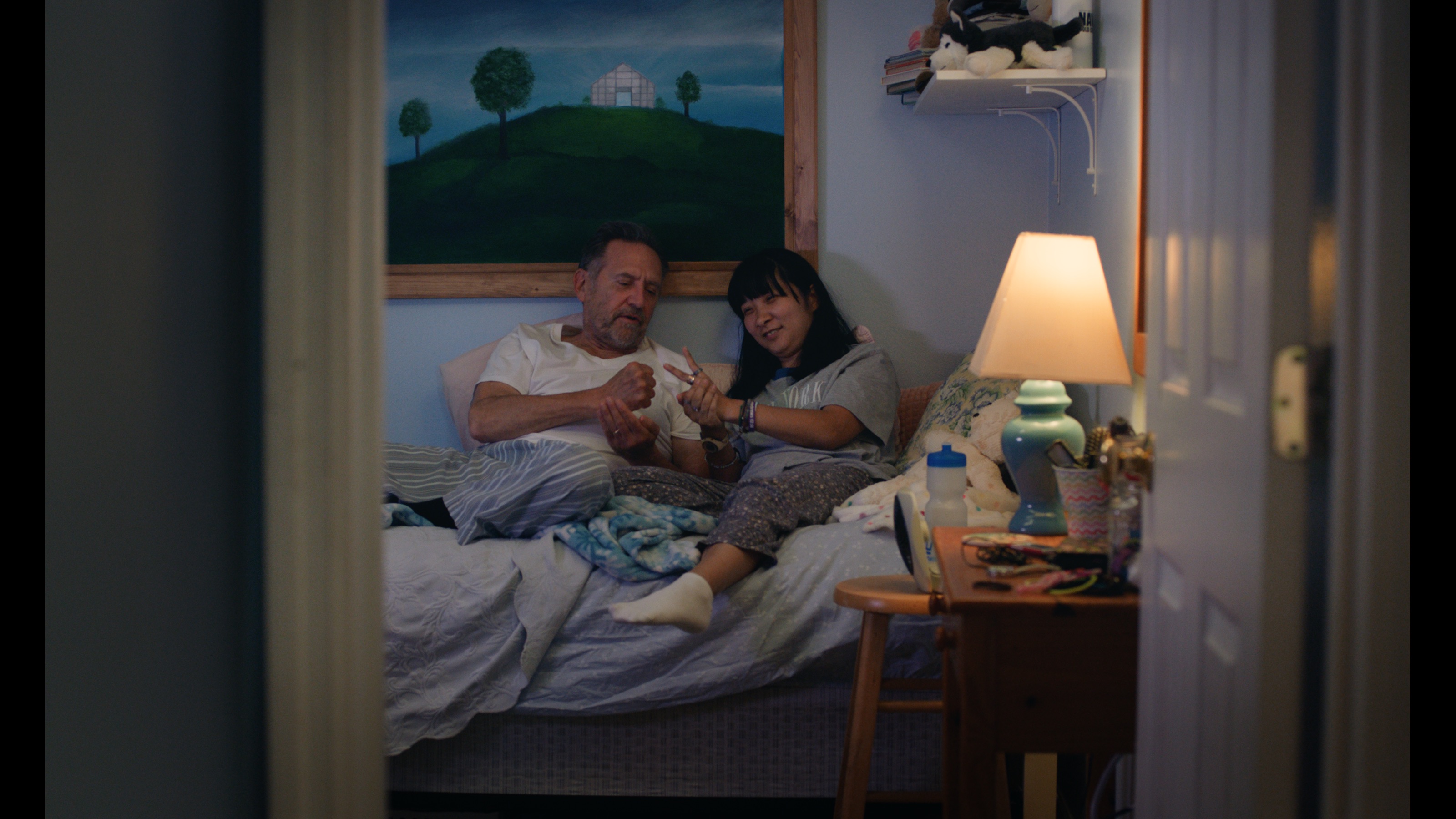
Ali Ahn and Anna Sargent in Take Me Home.
Ali Ahn on the Realism of 'Take Me Home,' and How the Film Shows Us a Better World is Possible

Ali Ahn stars in Take Me Home, a new film from Korean American director and writer Liz Sargent, coming to streaming November 15. The film explores the challenges of surviving in a society where any change in precarious caregiving setups can upend lives.
Based on her 2023 short film of the same name, Take Me Home draws on Sargent’s real-life experiences growing up with a sister who has a cognitive disability, and explores how American healthcare systems are not set up to support families like hers. Anna (played by Sargent’s sister Anna Sargent) is both the caregiver to her aging parents, as well as the recipient of their care. Her older sister Emily (Ali Ahn) is called back home after their mother dies and their father begins experiencing cognitive change. We sat down with Ahn to discuss what makes a seemingly niche story so universal, and the importance of belief in a better future.
Take Me Home is really going to resonate with folks who are taking care of elderly parents or a family member who's disabled. What in particular drew you to this script?
I think the complexity of the relationships, honestly. Obviously I was looking at the dynamic of the two sisters, but I loved that [Liz Sargent] presented that relationship in its full complexity. I feel like sometimes with stories, especially around disability, there can be kind of a preciousness with which we portray those relationships, or a kind of hero's journey. And I loved that the sister relationship was full of love, but also full of frustration and resentment and guilt. And I think that is very real and I really appreciated that. I thought that the fight scenes between them––I mean, they're sisters first and foremost, disability or not. And I think that she takes such an honest slice of family life. Caregiving is obviously a huge aspect of the daily routine, but it's infused with all the years of complicated relationship things that happened way before the moment of caregiving has to happen.
And it's so unique in that it's showing the caregiving both from Anna towards her parents and the parents towards Anna, which you don't usually see in a film.
Exactly.
I imagine it must have been emotional on set working with Liz's sister, Anna, knowing that this was based on events in her real life.
Yeah. I always felt a sense of responsibility that is different from a story that's purely fictitious. I mean, it's derived from actual conversations that Liz has had with Anna. I think that filming in their parents' home and in Anna's actual bedroom at the time just helped connect to what the reality of that family situation is, but I did feel like it was very hard to disconnect with the urgency of the story. I think that sense of responsibility actually only helps the film. I think it helps audiences connect to the film because it's not real, there's a lot of improv, but it is absolutely real. I think you can feel that in what you see on screen.
Can you tell me a little bit more about the improv involved?
It was a structure that was created in order to make sure that Anna could participate fully and bring her full self to the process. I think Liz experimented with it during the short film. Liz had this beautiful script that she had written, and then she would let us do these kind of long takes that were sometimes 15, 20 minutes long where she really gave over agency to us to basically try to capture the scene as it was written on the page, and know what the story points were that were necessary in order to get to the next scene, but also give room for Anna to play. And sometimes Anna didn't feel like dealing with whatever story aspect we were doing that day. It really put us in the position of being both completely present, and willing to change if Anna went in a direction that was actually more interesting (and also try to circle back and try to still hit the points in whatever order that we could so that later on we could have something in the editing room that Liz could use). It really afforded maximum flexibility, but it also meant that there were a lot of takes where there's nothing happening.
That's so fascinating. I had no idea about that because it just seemed so seamless watching the movie.
Oh yeah. Bless Liz and the editors in that room. I think there's a lot of the magic in the film that was completely unscripted. All the stuff with Anna playing basketball, I mean she is an amazing basketball player, but that came out of the dynamic between her and Shane [Harper], the actor. And I think my favorite moment in the film with Anna is this fight sequence where there was a fight as it was written on the page, but my God, Anna was so brilliant that day. She started adding lines. She was actually supposed to walk off camera, but off camera, she started yelling at me about how much she hated me and how mad she was at me as her sister. And it was so perfect for what that scene needed and really heartbreaking, and that was completely improvised.
Can we talk a little bit about the ending? It sort of calls back to that “if this world was different” line earlier in the film. How did you feel about it and the resolution at the end?
The fact that people don't know whether it's heaven, or get so excited that they ask, "Where is this place? I didn't know that this place could exist." All of those responses are really telling. I think there is a community in the Netherlands that is kind of like that. People derive so much hope from the ending, and that’s the feeling we should take into, “Well, how can we work towards creating a space like that?” It wouldn't take that much to shift, and so many people would benefit. I know in terms of what I learned about myself and what it required of me as an artist to work on this film, we all grew. It's not just Anna that grew in the process, I grew in the process. And so a community where people can interact in this way and everybody can contribute is really meaningful. I think that ending is really powerful and it resonates. Whether you think it's imagined or whether you think it's real, it actually has the same effect on audiences.
So in addition to Take Me Home coming out on streaming, you've got season four of The Diplomat out on Netflix as well. You play Eidra Park, head of the CIA. Did you feel pressure being an Asian woman in that position? And how did you craft a character when there hasn't really been anyone who looks like you in that role?
Yeah, that's so interesting. I think I always feel pressure as an Asian American actor in anything I do. I worry, am I perpetuating a stereotype? What can I do to humanize this character? Especially because as Asian Americans on screen, we're often tasked with playing very efficient and very intelligent characters, which is not necessarily bad, but it is one dimensional. I think my biggest concern with this character was seeming too—this is my least favorite word—inscrutable, which is a kind of trope that we see. I was really nervous about that, even though obviously as a spy and as part of her job, an element of inscrutability obviously is a skill.
The first season in particular, where I wasn't sure where the character was going, I really tried to eke out any opportunity to subvert or humanize her. I think a lot of that came through the humor. I will just say that as an actor you are confined by the writing, and in other roles, it doesn't matter how much you try to characterize or add nuance, you're limited by what is on the page. And so it's really a gift that these writers wrote in these little windows into Eidra's vulnerability. I do feel like the thing that I wanted to make sure that people could see was that even if she presents as so capable, so competent, so unflappable––which she is––there is an emotionally messy, complicated core inside that only comes out in little flashes.
Watch Take Me Home beginning November 15 on Apple TV, Google, Vudu/Fandango and Amazon. The Diplomat is out now on Netflix.