Marisa Hamamoto and Adelfo Cerame Jr.
How One Dance Company is Changing Perceptions of Disability
An Interview with Marisa Hamamoto
.png)
Infinite Flow Dance is a disability-led professional dance company based in Los Angeles. For Founder, CEO, and Creative Director Marisa Hamamoto, the idea to form the company arose from the question, “Who is left out?” We spoke with Hamamoto about her identity as an Asian American, a stroke survivor, and an autistic woman.
As a child, Marisa Hamamoto dreamed of becoming a ballet dancer. Hamamoto grew up in Irvine, California, in the 80s and 90s, at a time when the Southern California suburb was predominantly white and unwelcoming to Japanese Americans like herself. At school, she was picked on for looking different. Hamamoto found a sense of belonging in her weekly afterschool ballet class, but as she got older and entered her teen years, she began to be told that her body wasn’t right for dance.
“I think I started to live in this duality where I knew in my gut that dance is a universal language that belonged to everyone, yet dance seemed like it was only accessible for a few people.”
During her senior year of high school, Hamamoto attended Idyllwild Arts Academy, located in the mountains a couple of hours away from LA. The school was well known for its diversity and inclusion. As seniors, students had the opportunity to choreograph a six minute work for the end of the year student choreography concert. The 14 dance majors each got to choose their own music and cast.
“I was excited, not just because I got to choreograph something for the first time in my life, but I was really excited to be part of my peers' works. This was the first time in my 12 years of education where I felt very much like I was accepted and included. But when the casting notice came out, none of my classmates had selected me to be in their work.” Hamamoto was devastated, but then noticed that seven other students, mostly in the lower grades, were also excluded.
“I didn't think that was right. So on a whim, I took a pencil out of my backpack and wrote down all seven names into my own cast. Long story short, we had an incredible showcase. At commencement I was named Dance Major of the Year, for the leadership that I took at the student choreography dance concert.” As a result of Hamamoto’s actions, the school’s dance department changed their casting policies, allowing all students to participate. That policy remains in place today, more than 20 years later.

Shifting her mindset after a spinal stroke
This experience in high school planted a seed in Hamamoto’s mind. But it was her time in Japan that really changed the course of her life. She moved to Japan for college, attending Keio University in Tokyo. She put dance on the back burner and decided to focus on academics. Despite her heritage, being accepted in Japan was a challenge. “I was a very rare case where as a fourth generation Japanese American, I spoke the language fluently and didn't have an accent,” Hamamoto said. “But despite that, it was very, very difficult for me to fit in.”
In her senior year of college, during an off-campus dance class late at night, Hamamoto had a spinal stroke that initially paralyzed her from the neck down. This experience changed her perspective on life, and on dance. “It took a few years to get back into life, get back into dance, but I miraculously regained most of my mobility. I still have some paralysis in my left hand. My left side is slightly paralyzed. But I don't really consider myself to have a physical disability anymore.”
Is there something wrong with me? No, there isn’t anything wrong with my body or my ethnicity. The problem is the biases in society.
Marisa returned to dance, getting certified as a professional ballroom dance instructor. She moved to LA and attempted to break into the entertainment industry. But her auditions were met with the same rejections she had faced in the past. She was told she didn’t fit the “look” of a Hollywood dancer. The roles she was called in for were stereotypical. “I've been flat out told, ‘well, you're Asian and you just don't fit the role of ballroom and salsa dancers.’ And so then I started to question myself. Is there something wrong with me? No, there isn’t anything wrong with my body or my ethnicity. The problem is the biases in society.”
Building a dance company rooted in disability inclusion
Hamamoto reflected on who else was being left out of dance. And as a spinal stroke survivor herself, her thoughts turned to disabled people. Just as she had done in high school, Hamamoto made the decision to make dance more inclusive, envisioning a company that celebrated diverse bodies and minds. “That was when I metaphorically took out the pencil and said, okay, let's create a dance company around who is left out and let's see where this goes.” Hamamoto founded Infinite Flow Dance in 2015. Founding artists included Adelfo Cerame Jr., a Filipino American competitive bodybuilder and spinal cord injury survivor.
The mission of Infinite Flow Dance is to advance disability inclusion and reimagine possibilities, one dance at a time. The company includes dancers that have both apparent and non-apparent disabilities—there are dancers who have physical disabilities as well as neurodivergence, dancers who are deaf, blind, have learning disabilities, intellectual disabilities, and a variety of chronic illnesses. “According to the CDC,” Hamamoto says, “1 in 4 people have a disability. So that's 61 million Americans. And people ask, ‘where are the disabled people?’ Well, 70 to 80% of disabled people have non-apparent disabilities.”
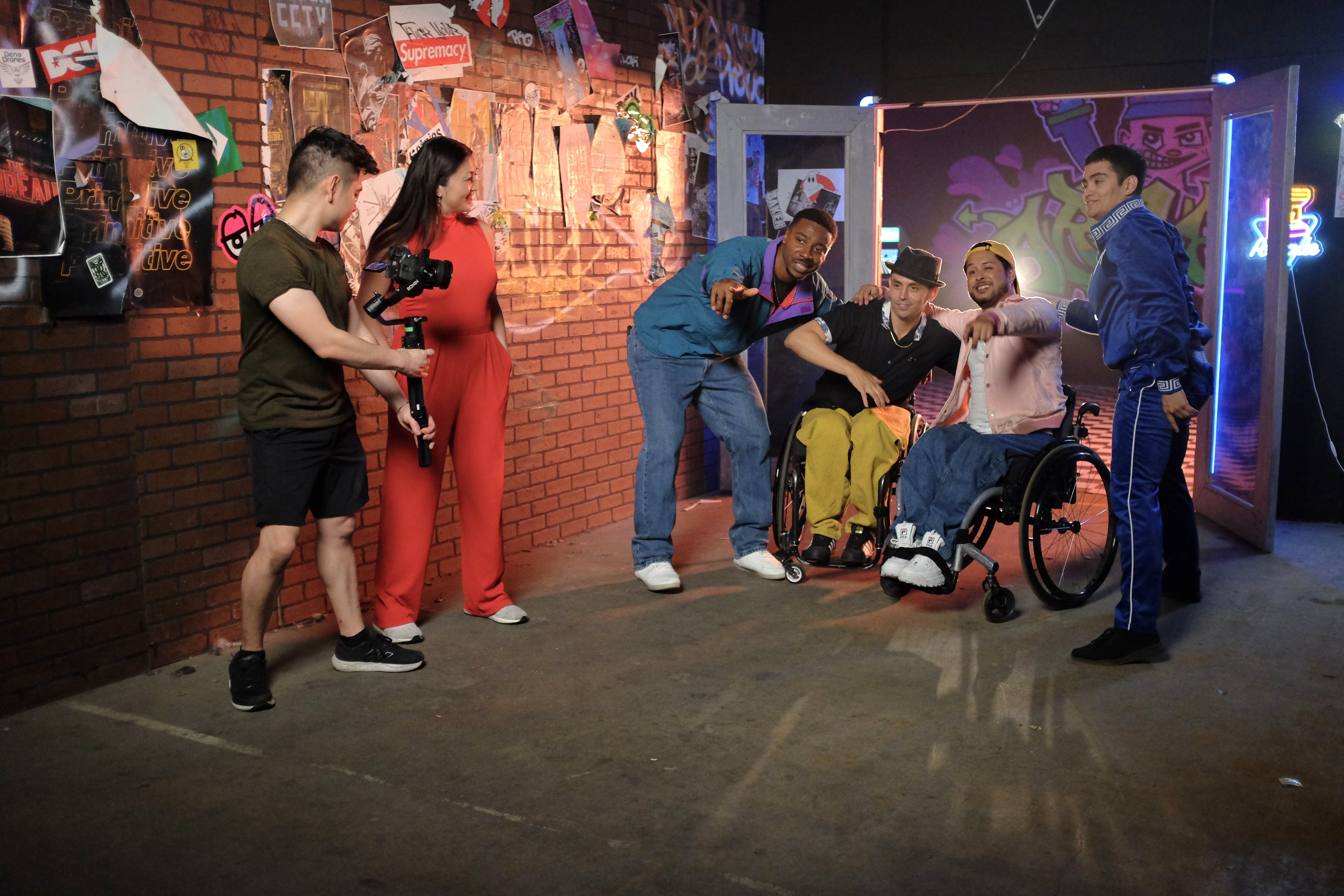
Infinite Flow’s performances and dance films get people to see disability in a different way, transforming expectations of what’s possible. Their performances are powerful testaments to strength and creativity. The company has performed and partnered with corporations including Google, Apple, Red Bull, and Adidas. They also perform at school assemblies where, Hamamoto says, “there's this shift that happens just in 45 minutes on the perception of disability.”
And while there has been an overwhelmingly positive response to what Infinite Flow Dance is doing, Hamamoto feels the dance community and society as a whole still have a long way to go in becoming more inclusive and accessible. Despite good intentions, true integration into the dance community remains elusive for many dancers with disabilities. To counter that, Infinite Flow Dance is piloting an accessible dance certification program in the coming year, targeting dance educators, dance studio owners, and dance program leaders.
Opening up about autism within the Asian American community
In addition to being a spinal stroke survivor, Hamamoto was recently diagnosed with autism at age 40. When asked about the overlaps between fighting for disability inclusion and inclusion for Asian Americans, Hamamoto shared that she’d like to see more representation for both—and at the intersection—in every single industry, from the media to corporate and nonprofit leadership. However, she noted an interesting paradox. “In disability spaces, I sometimes feel my Asian American identity takes a back seat. At the same time, in Asian American spaces, I sometimes question whether to share my autism.”
This phenomenon is unfortunate, because according to a 2023 study, children who identified as Asian had higher rates of ASD diagnosis compared to children from other racial groups. 1 in 19 Asian children were diagnosed with autism. Hamamoto said that after she disclosed her diagnosis publicly on social media, she began to get DMs from Asian American parents of children with disabilities, as well as Asian women who themselves were diagnosed late in life, or are questioning.
Hamamoto wants to shed light on the experiences of neurodivergent Asian American children. She is in the early stages of working on a short film about a young, nonverbal Asian American girl. For Hamamoto, these are the types of stories that she hopes will be lifted up in the AAPI community.
To learn more about Infinite Flow Dance, visit their website or follow them on Instagram. You can also connect with Marisa Hamamoto on LinkedIn and her website.